🛟 The course project help
How to choose, build, write up and present your structural estimation project
The project is where the course comes together: you build one structural model from the ground up, solve it, simulate it, estimate it and use it for a counterfactual. It carries 70% of the grade, together with the presentation and the oral exam, and it is individual.
Timeline
| When | What |
|---|---|
| now | think about a model and a question; talk to me early |
| Thursday, November 5 | project proposal due, at most 2 pages |
| Tuesday, November 10 | project clinic: every proposal is discussed in class |
| November | build the model, the solver, the simulator and the estimator |
| Tuesday, December 1 and Thursday, December 3 | presentations, about 30 minutes each, with a live demo |
| before the exam week | the paper and the documented code are submitted |
| exam period | oral exam, with the paper and the code as the starting point |
Do not leave the code for the last two weeks. The solver usually takes longer than planned, and everything else depends on it.
What a structural project consists of
The components of a structural estimation project of Class 1 are the checklist. A complete project has:
A model: agents, their choices, states and transitions, preferences and constraints, written down precisely enough that someone else could code it
A solver: code that computes the policy (and value) functions for any parameter values, with evidence that it is accurate
A simulator: code that generates data from the model at given parameters
An estimator: NFXP, CCP, NPL, MPEC or MSM, with standard errors
Data: real data, or simulated data from the model with known parameters
Identification: an argument for which features of the data pin down which parameters
A counterfactual: a change in policy or environment, simulated with the estimated model, that answers a question
The aim is a project that works end to end, from the model to the counterfactual. A small model done completely beats an ambitious model that never gets estimated.
The main line and its alternatives
Every project starts from the same place, a model written as Bellman equations. From there the main line takes the model to real data, but two other kinds of projects are equally welcome:
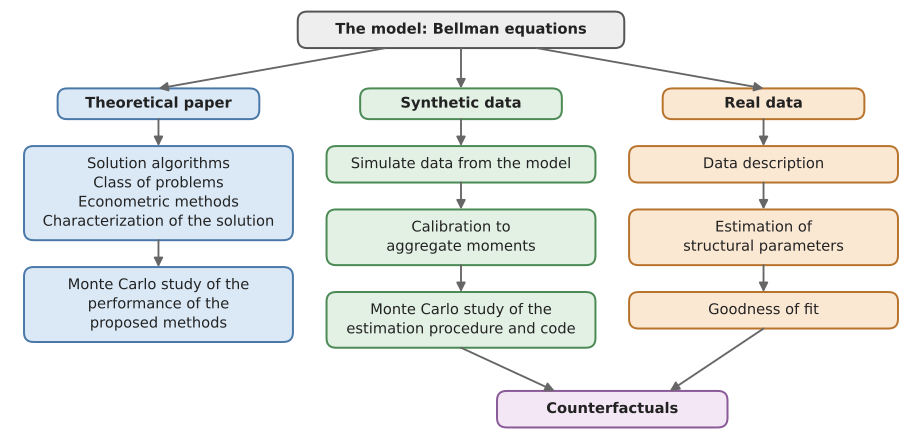
Three paths from the Bellman equations to a project.
Real data, the main line: describe the data, estimate the structural parameters, assess the goodness of fit, and use the estimated model for counterfactuals
Synthetic data: simulate data from the model, calibrate it to some aggregate moments, and run a Monte Carlo study of the estimation procedure and the code; the counterfactuals are computed as on the main line. A good choice when the data you need are not available in the time of the course
A theoretical paper: new solution algorithms, a class of problems they solve, econometric methods, or a characterization of the solution, followed by a Monte Carlo study of the performance of the proposed methods
The structure of the paper stays the same on every path; what changes is the content of the application, the data and the results sections.
Choosing a model
There are two routes, and both are fine.
Extend a model from class. The course has built the full pipeline for several models, and the code is in the course code repository:
the bus engine replacement model of Classes 9–14, estimated by NFXP, CCP and NPL
the inventory management model of Class 7
the consumption-savings model of Classes 15–17, solved by VFI, time iterations and EGM
the consumption-savings-retirement model of Class 18, solved by DC-EGM and estimated by MSM in Class 20
the equilibrium and game models of the last part of the course
An extension adds something economically meaningful: a new state variable (health, experience, a second asset), a new choice (part-time work, a second machine), unobserved types, a different market structure, or a policy instrument (a pension, a tax, a safety net). Mechanical changes of a parameter value are not an extension.
Bring your own model. A model from your own research interest is welcome, and often makes the best project. Keep it small:
one or two state variables
one discrete choice, or one continuous choice, or one of each
a handful of structural parameters
a solver you can run in seconds, otherwise you’ll spend too much time waiting
Before you commit, check three things: that the model can be solved with a method from the course, that its parameters are identified from data you can get or simulate, and that there is an interesting counterfactual.
What question would your counterfactual answer, and who would care about the answer?
Which method of the course solves your model, and which estimates it? Why those?
The proposal
The proposal is due on Thursday, November 5, at most two pages, and it is the plan we discuss in the project clinic on Tuesday, November 10. It should contain:
the question: one or two sentences, and the counterfactual that answers it
the model: states, choices, transitions, utility, constraints, the timing, and the parameters to estimate
the solution method, and why it fits the model
the data: the source, or the plan to simulate it, and the observed variables
the estimation method and the moments or the likelihood
a roadmap: the steps in order, what you already have and what is the main risk
references: the two or three papers the project builds on
A good proposal is specific. “I will estimate a model of retirement” is not a plan; “I will add a part-time work option to the retirement model of Class 18 and estimate the disutility of work by MSM from simulated employment profiles” is.
Make sure that your code works as expected
A structural estimate is only as credible as the code behind it. Convince yourself that the code is right, and include some tests in the final product.
Accuracy of the solver. Use the checks of the course: an analytic special case, Keane’s test, Euler equation residuals, convergence as the grid is refined
Recovery of known parameters. Simulate data from the model at parameters you choose, estimate, and check that you get them back within the standard errors. A small Monte Carlo, as in Class 20, is the strongest evidence that the estimator works
Identification. Plot the likelihood or the criterion around the estimate, along each parameter. A flat direction means a parameter the data do not pin down
Robustness of the optimizer. Start from several points; report what happens
The paper
The paper is individual work, and it contains the main steps of a structural research paper, in this order:
Introduction and literature review: the question, why it matters, what you do and what you find, and how the project relates to the closest papers
The application domain: the economic setting that motivates the model, the institutions and the facts the model has to capture, and the data, real or simulated, with descriptive statistics
Model: the agents, their choices, states and transitions, preferences and constraints, the timing, and the Bellman equations; every symbol defined
Solution and estimation method, identification: the algorithm that solves the model, with its accuracy checks and run time; the estimator, the likelihood or the moments, and the standard errors; which features of the data identify which parameters
Estimation results and goodness of fit: the estimates with standard errors, and how well the estimated model fits the data, including the features it does not fit
Counterfactuals: the change in policy or environment, what the estimated model predicts, by how much, and why
Conclusion, limitations and further directions: what was learned, what the model leaves out and how that could matter, and what you would do next
Put the details of the algorithm and the additional checks in an appendix. Every table and figure must come out of the notebook, and the text must agree with the numbers in them.
Write for an economist who has not taken this course: define the notation, explain the choices, and say where the method or the model breaks. Cite the papers you build on with full references.
The presentation
The presentations take place on December 1 and 3, about 30 minutes each, with questions. Plan for about 20 minutes of talk:
the question and the model, in a few slides
the solver and the estimator running live: show the code, solve the model, show the simulated data and the fit
the estimates and the counterfactual
what does not work yet, and what you would do with more time
A live demo that fails is not a disaster; a demo that you cannot explain is. Rehearse it on the computer you will present from.
The oral exam (to be confirmed)
The paper and the code are submitted before the exam week, and they are the conversation starter of the oral exam during the exam period. Expect questions about:
the economics of the model and the counterfactual
the solution method and why it works for your model
the estimator, the standard errors and identification
any line of your code: what it does, why it is written that way, and how you would change it
Using AI tools
The AI policy of the course applies in full. You may use AI tools for the project, and you are responsible for every line of code and prose they produce for you: you have to understand it, verify it, and be able to modify it on the spot in the oral exam. Disclose the use of AI assistants beyond text editing as described in the disclosure policy.